AI in companies⭐
All about the EU AI Act
All about the EU AI Act
All about
the EU AI Act
The European Union's AI Act is a challenge for many companies. We have compiled the most important information.
![Missing alt text [EN]](https://res.cloudinary.com/dfcfhdy9c/image/upload/w_3840/f_auto/q_auto:good/v1746704037/EU_AI_ACT_g55jda.png)
What is the EU AI Act?
The EU AI Act is the world’s first comprehensive law regulating artificial intelligence. It classifies AI systems into four risk categories:
Unacceptable Risk
These AI systems will be banned. They include applications that manipulate or surveil people—such as social scoring or covert influence.High Risk
AI used in sensitive areas like healthcare, law, or education falls into this category. These systems must meet strict requirements for safety, data quality, transparency, and human oversight.Limited Risk
This includes tools like chatbots, voice assistants, and generative AI like ChatGPT. Users must be clearly informed that they are interacting with AI, and AI-generated content must be labeled accordingly.Minimal Risk
All other AI systems—like spam filters or AI in video games—fall into this group. These are subject to very few restrictions.
The goal of the EU AI Act is to foster innovation while protecting people’s fundamental rights.
It came into effect in August 2024 and must be fully implemented by August 2026.
![Missing alt text [EN]](https://res.cloudinary.com/dfcfhdy9c/image/upload/w_3840/f_auto/q_auto:good/v1737979058/Ginger_Check_Anforderungen_KI_small_wnmxcc.jpg)
Unacceptable Risk
These AI systems will be banned. They include applications that manipulate or surveil people—such as social scoring or covert influence.High Risk
AI used in sensitive areas like healthcare, law, or education falls into this category. These systems must meet strict requirements for safety, data quality, transparency, and human oversight.Limited Risk
This includes tools like chatbots, voice assistants, and generative AI like ChatGPT. Users must be clearly informed that they are interacting with AI, and AI-generated content must be labeled accordingly.Minimal Risk
All other AI systems—like spam filters or AI in video games—fall into this group. These are subject to very few restrictions.
The goal of the EU AI Act is to foster innovation while protecting people’s fundamental rights.
It came into effect in August 2024 and must be fully implemented by August 2026.
Webinars on the topic
Successfully tackling the EU AI Act



![Missing alt text [EN]](https://res.cloudinary.com/dfcfhdy9c/image/upload/w_3840/f_auto/q_auto:good/v1718282424/EU-AI-Act_vchvlm.png)
Ready for the EU AI Act?
Artificial intelligence has become an integral part of modern companies. It automates processes, relieves the burden on sales, marketing and customer service and speeds up document processing - a real game changer.
However, with the introduction of the EU's new AI regulation, the pressure on companies to ensure the secure, transparent and traceable use of AI is growing. Data must be protected and all usage must be fully logged.
To help you overcome this challenge, we have created a guide with all the points you need to consider.
Download the white paper now.
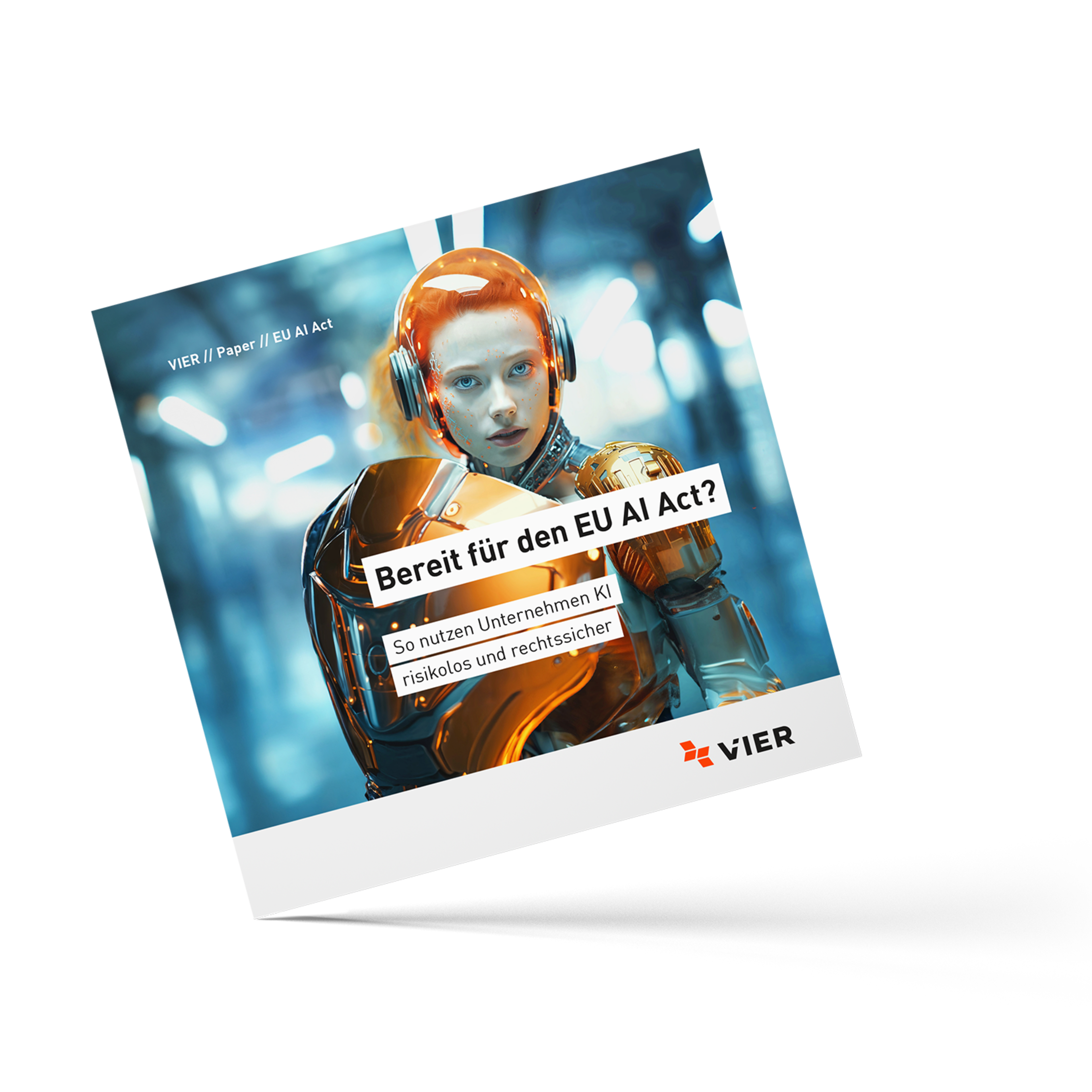
Artificial intelligence has become an integral part of modern companies. It automates processes, relieves the burden on sales, marketing and customer service and speeds up document processing - a real game changer.
However, with the introduction of the EU's new AI regulation, the pressure on companies to ensure the secure, transparent and traceable use of AI is growing. Data must be protected and all usage must be fully logged.
To help you overcome this challenge, we have created a guide with all the points you need to consider.
Download the white paper now.

How to use AI safely and in compliance with the EU AI Act
VIER has developed the VIER AI Gateway to use AI securely. Thanks to Guardrails, Privacy Manager and the like, you can use AI risk-free and in compliance with data protection regulations.
More about VIER AI GatewayWhat companies need to know now
![Missing alt text [EN]](https://res.cloudinary.com/dfcfhdy9c/image/upload/w_3840/f_auto/q_auto:good/v1733220623/KI-Cybersicherheit_cvybhg.jpg)


Talk to our experts